


Mogao Caves
According to an inscription from the Tang Dynasty, the first cave at the Mogao Caves was constructed in AD 366. In 1987, the United Nations Educational, Scientific and Cultural Organization (UNESCO) inscribed the Mogao Caves on the World Heritage List. Archaeologists consider the site one of the world’s largest and best-preserved collections of Buddhist art.
Despite centuries of natural erosion and human-caused damage, 492 caves have survived in remarkably good condition. Covering nearly 45,000 square meters, the murals, more than 2,000 painted sculptures, and the five wooden facades at the cave entrances represent one of the most extraordinary examples of cultural heritage in the world.
The murals portray pavilions, towers, temples, pagodas, palaces, courtyards, towns, and bridges, providing invaluable insight into the development of traditional Chinese architecture. Many paintings also depict Chinese and foreign musicians, dancers, and acrobatic performances, reflecting the rich cultural exchanges along the Silk Road.
Discovered in 1900 by the Taoist monk Wang Yuanlu, the Library Cave contained approximately 50,000 sutras, manuscripts, and paintings dating from the 4th to the 11th century. Regarded as one of China’s greatest archaeological discoveries, this remarkable collection remains an invaluable source for the study of history, religion, art, and culture.

Reklam.


Dunhuang and the Library Cave
The Mogao Caves in Dunhuang are an extraordinary cultural treasure consisting of 492 caves, nearly 45,000 square meters of murals, more than 2,400 painted sculptures, and five wooden facades decorating the cave entrances. The site also yielded approximately 50,000 Buddhist manuscripts, historical documents, textiles, and numerous archaeological artifacts that attracted worldwide attention when they were discovered in the early 20th century.
Also known as the Thousand Buddha Caves or the Dunhuang Caves, the Mogao Caves are located about 25 kilometers southeast of the Dunhuang Oasis in China’s Gansu Province, along the historic Silk Road. For centuries, this oasis served as a vital crossroads where Eastern and Western civilizations met, fostering trade, religion, and cultural exchange.
Construction of the caves began in AD 366 and continued for nearly a thousand years, creating one of the finest collections of Buddhist art in the world. Together with the Longmen Caves and the Yungang Grottoes, the Mogao Caves are regarded as one of China’s three greatest Buddhist cave temple complexes.
According to local legend, the Buddhist monk Le Zun witnessed a magnificent vision of a thousand Buddhas shining in the sky in AD 366, inspiring him to begin carving the first cave. Over the centuries, hundreds of caves were added, transforming the site into a major center for Buddhist worship, meditation, and learning. Sacred scriptures brought from the West were preserved here, while pilgrims and artists traveling along the Silk Road enriched the caves with magnificent murals.
The paintings served not only as works of art but also as visual aids for meditation, educational tools for teaching Buddhist philosophy, and a way of communicating religious stories to people who could not read or write. Together, the murals and architecture represent an artistic expression of the Buddhist path to enlightenment.
The mural paintings cover approximately 45,000 square meters. After the 11th century, some caves were converted into repositories for worn-out Buddhist scriptures, ancient manuscripts, and sacred objects. The most famous of these became known as the Library Cave, a hidden chamber sealed for centuries. Its rediscovery in 1900 is considered one of the greatest archaeological discoveries in the history of China and one of the most significant manuscript finds in the world.


Discovery
In the early 1900s, a Chinese Taoist monk named Wang Yuanlu became the caretaker of several temples at the Mogao Caves. While clearing and maintaining the site, he discovered a sealed chamber hidden behind a wall along one of the main cave corridors. Behind the wall was a small cave containing an extraordinary collection of manuscripts dating from AD 406 to 1002. The cache included ancient hemp-paper scrolls written in Chinese and several other languages, paintings on hemp, silk, and paper, damaged Buddha statues, and numerous Buddhist ritual objects.
The manuscripts covered an impressive variety of subjects. Besides Buddhist canonical texts, they included original commentaries, apocryphal writings, study manuals, prayer books, Confucian and Taoist works, Nestorian Christian texts, official Chinese government documents, administrative records, anthologies, dictionaries, and calligraphy exercises. Wang later sold many of these manuscripts to the British-Hungarian explorer Sir Aurel Stein for only £220, a decision that remains highly controversial in China.
News of the discovery soon attracted several European expeditions to Dunhuang. These included the British-Indian expedition led by Aurel Stein, who collected hundreds of copies of the Diamond Sutra, the French expedition headed by Paul Pelliot, the Japanese expedition led by Otani Kozui, and the Russian expedition under Sergei F. Oldenburg. Each expedition acquired and studied important portions of the manuscript collection.
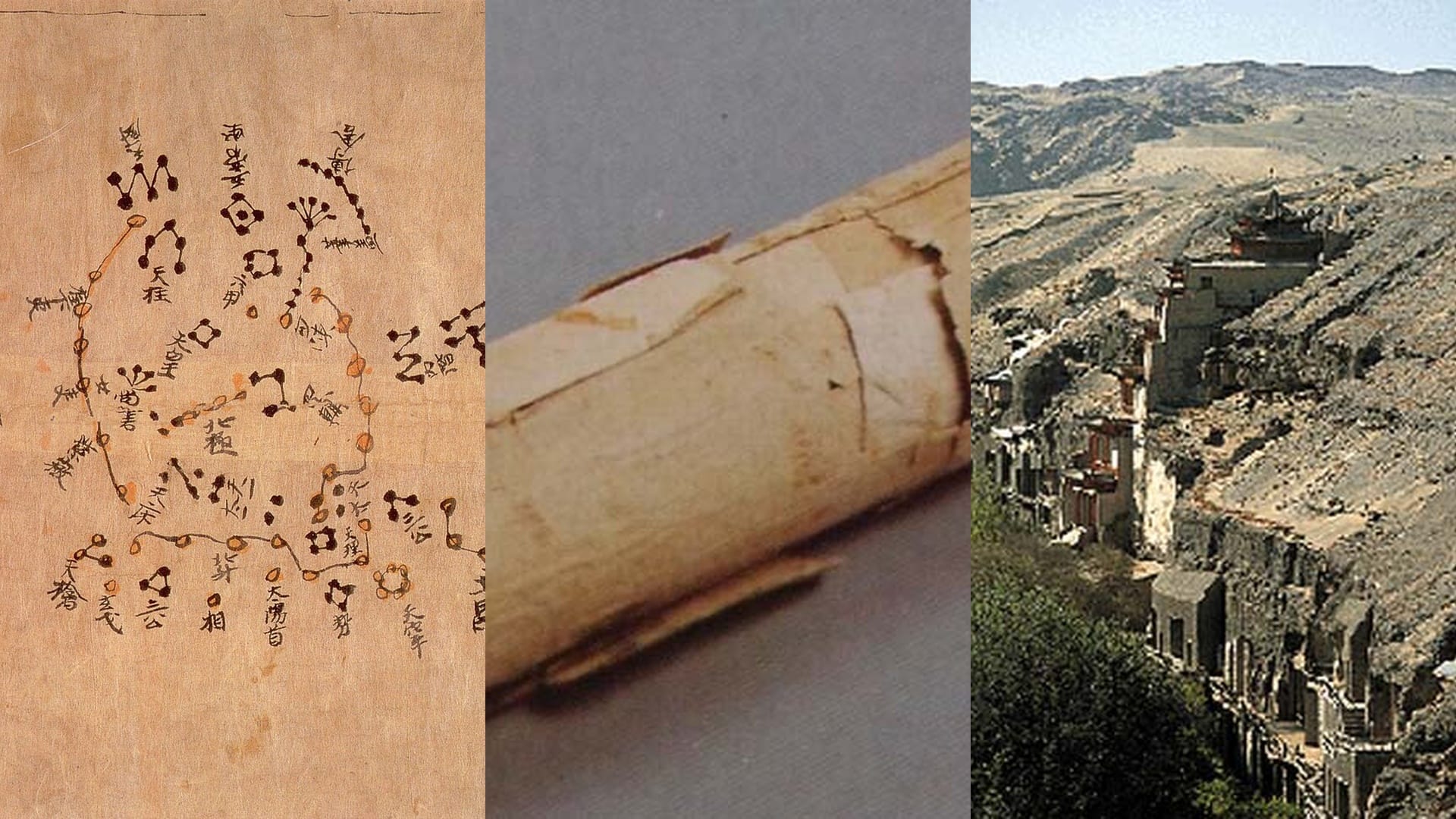
Paul Pelliot focused on rare historical documents concerning the administration and finances of the monastery and its associated communities. Many manuscripts survived because Buddhist texts had been written on the reverse side of previously used paper, creating a type of palimpsest. The remaining Chinese manuscripts were later transferred to Beijing by order of the Chinese government. With donations from nearby towns, as well as financial support from Stein and Pelliot, Wang Yuanlu undertook an ambitious restoration of the temple complex. Among the most remarkable discoveries was the Dunhuang Star Map, now recognized as one of the oldest surviving astronomical maps in the world.
Today, the Mogao Caves continue to be the subject of extensive archaeological research. In 1987, the site was inscribed on the UNESCO World Heritage List, recognizing its outstanding historical, artistic, and scientific significance.
Mogao Caves Vikipedia
Dunhuang Star Map


According to research, the Dunhuang Star Map, most likely dating to the 7th century AD, depicted the night sky with an unprecedented level of accuracy until the Renaissance. Considered one of the oldest surviving handwritten star maps in the world, it is regarded as one of the most remarkable treasures in the history of astronomy.
The map is drawn on a thin paper scroll measuring approximately 210 × 25 centimeters and depicts 1,345 stars arranged within 257 star groups (asterisms). A star chart of such precision would not appear in Europe until centuries later, after the invention and widespread use of the telescope. This demonstrates the extraordinary sophistication of Chinese astronomy during its time.
The map includes not only bright stars but also many faint stars that are difficult to observe with the naked eye. In addition, the celestial sphere is projected onto a cylindrical surface while preserving its overall geometry. This projection technique was employed in China centuries before similar methods became common in Europe during the 15th century.
The first section of the manuscript contains texts related not to astronomy itself, but to cloud divination. This indicates that celestial observations in ancient China served not only scientific purposes but were also closely connected to government affairs, agriculture, and systems of divination.
According to astronomers Dr. Françoise Praderie and Dr. Jean-Marc Bonnet-Bidaud of the Paris Observatory, the exact purpose of the map remains uncertain. However, researchers believe it may have been used for military planning, long-distance navigation, and interpreting celestial signs for divination. They also suggest that the Chinese tradition of carefully observing the heavens led to the creation of one of the earliest and most accurate star catalogs in human history.


