


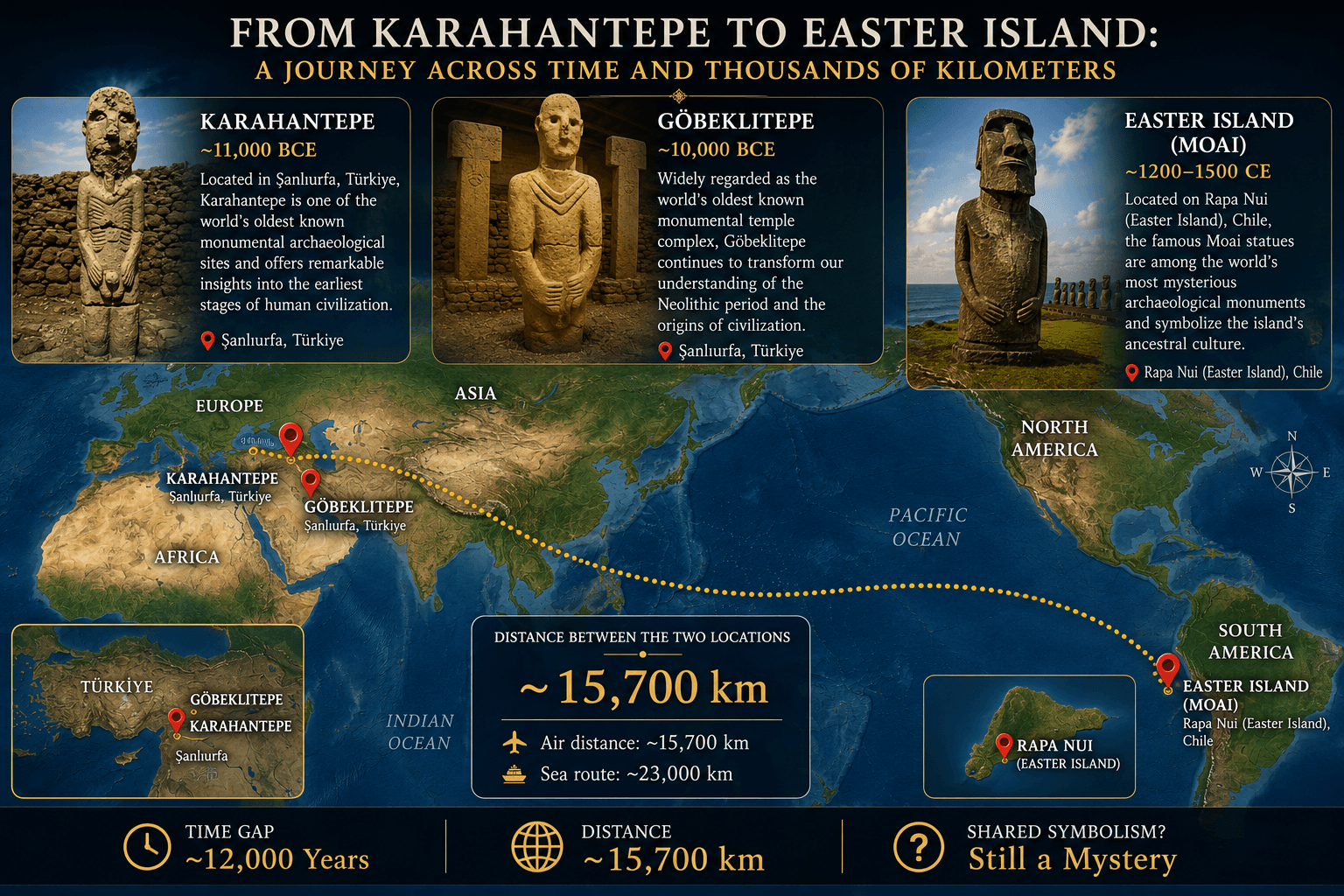
Throughout human history, striking similarities can sometimes be found among statues created by societies separated by thousands of years and vast geographical distances. One particularly intriguing similarity can be observed in the human statue from Karahantepe, the anthropomorphic figures associated with the Göbeklitepe cultural world, and the famous Moai statues of Easter Island: their arms extend downward along the sides of the body, while their hands are positioned over the lower abdomen, navel, or genital region.
Could this shared posture simply be an artistic choice? Or are the hands deliberately pointing toward a part of the human body once regarded as special or sacred?
More importantly, could this posture reflect a universal human symbolism connected with life, reproduction, fertility, lineage, continuity, and ancestors?
Karahantepe: Are the Hands Pointing to the Source of Life?
Dating back approximately 11,000 years, Karahantepe is one of the world’s oldest known monumental settlements. One of the remarkable human statues discovered there depicts a male figure whose arms extend down both sides of the body, while his hands are positioned directly around the genital area. The explicit representation of the male sexual organ immediately raises the possibility that the figure may have been associated with reproduction, masculinity, fertility, or vital force.
Of course, we cannot state with certainty that this statue represents a fertility god. Since no written records exist from the Neolithic period, the statue’s name, identity, and original purpose remain unknown. The figure could represent a deity, an ancestor, a shaman, an important individual, a mythological being, or an entirely different concept.

Reklam.
Yet from an iconographic perspective, an intriguing symbolic sequence emerges:
Male sexuality → reproduction → emergence of life → continuation of lineage → ancestors → survival of the community


For this reason, interpreting the Karahantepe statue solely in terms of sexuality may be too limited. Perhaps its hands frame the part of the human body believed to contain a creative and life-giving power.
The central question is simple: Why did the sculptor deliberately place the hands in this particular area?
If the purpose had merely been to represent the human body naturally, the arms could simply have hung freely at the sides. Instead, the deliberate positioning of the hands toward the genital region suggests that this anatomical area may have carried special symbolic significance.
Göbeklitepe: A More Abstract Version of the Same Posture?
At first glance, the enormous T-shaped pillars of Göbeklitepe may appear to be geometric stone monuments. However, the presence of carved arms, hands, belts, and clothing-like elements indicates that at least some of these pillars represent anthropomorphic, human-like beings.
These beings have no visible faces. They have no eyes, mouths, or facial expressions. Yet their arms and hands are clearly represented.
And once again, the hands point toward the lower part of the body.
On some of the central T-shaped pillars, the arms extend down along both sides of the torso, while the hands are positioned around the lower abdomen and belt area. Whether these figures represent gods, ancestors, spiritual beings, or some other kind of sacred entity remains unknown.
However, considering that Karahantepe and Göbeklitepe belonged to the same broader Neolithic cultural world, an important possibility arises:


Could the life and reproductive center explicitly represented at Karahantepe have become more abstract and symbolic at Göbeklitepe?
At Karahantepe, the hands directly frame the genital region. At Göbeklitepe, they are placed around the lower abdomen and belt. In both cases, approximately the same area of the human body is emphasized.
This raises the possibility that the position of the hands was not merely an aesthetic convention but part of a deeper symbolic tradition.
Could This Idea Be Older Than the Concept of a Fertility God?
When we speak today of a “fertility god,” we usually think of named deities from Mesopotamian, Egyptian, Anatolian, Greek, or Roman civilizations. But Karahantepe and Göbeklitepe are thousands of years older than these historical civilizations.
There was no writing. We do not know the names of their gods, if they had gods in the sense later civilizations understood them. No mythological stories from these communities have survived in written form.
Therefore, identifying the Karahantepe figure directly as a “fertility god” would go beyond the available archaeological evidence. Yet we may be dealing with something even more fundamental and ancient:
The sacredness of the life-giving force itself.
Even before the full development of agriculture, humans faced the mysteries of birth, death, sexuality, and reproduction. The arrival of a new human being, the continuation of generations, and the emergence of new life after death may have occupied a central place in how early communities understood existence.
In this context, even before named fertility gods emerged, the following concepts may already have possessed sacred significance:
Life, birth, reproduction, lineage, ancestors, and rebirth.
Perhaps the Karahantepe figure did not represent a fertility god in the later historical sense. Instead, it may have embodied a much older idea: the creative force that brings life into existence.
Mesopotamia: When Reproduction and Fertility Became Divine
Thousands of years later, with the emergence of writing in Mesopotamia, we begin to learn the names, functions, and mythological stories of gods and goddesses. Agricultural abundance, fertility, sexuality, birth, death, and regeneration became explicitly connected with divine powers.
An important transformation may have occurred here.
The unnamed concept of a life force that may have existed in the Neolithic period could later have been personified through specific gods and goddesses.
This does not mean that there was necessarily a continuous, uninterrupted transmission of religious belief from Karahantepe to later Mesopotamian civilizations. Such a connection cannot currently be proven. However, the association between human reproductive capacity and sacred power repeatedly appears across many different societies.
Rather than seeing the Karahantepe statue as the direct ancestor of later Mesopotamian fertility gods, it may be more reasonable to view it as a very early example of humanity attributing sacred meaning to the power that creates and sustains life.
Easter Island: Why Are the Hands in the Same Place Thousands of Years Later?
Now we travel to the other side of the world, to Rapa Nui, better known as Easter Island, in the middle of the Pacific Ocean.
The monumental Moai statues were created approximately 10,000 years after the Karahantepe sculptures. There is no reliable archaeological evidence demonstrating a direct historical connection between the two cultures.
Yet when their bodily postures are compared, an intriguing similarity emerges.
The long arms of the Moai descend along the sides of their bodies. Their elongated fingers extend across the abdomen and toward one another.
Once again, we face the same question:
Why are the hands placed specifically there?
The Moai are generally interpreted as representations of important ancestors, chiefs, or powerful members of society. If so, the placement of their hands around the abdominal region may carry more than purely anatomical significance.
The concept of an ancestor is directly connected with lineage:
Ancestor → origin of lineage → generations → reproduction → continuity of life
From this perspective, without proposing any direct cultural connection between Karahantepe and the Moai, we can consider the possibility that a common human idea independently emerged in different periods and places.
What Are the Hands Really Pointing To?
In the human body, the navel, lower abdomen, and genital region form three closely situated centers, each of which can be associated with the origin of life.
The navel marks the place where a human being was physically connected to the mother before birth.
The lower abdomen contains the womb, where human life develops.
The genital region is directly connected with biological reproduction.
For early humans, therefore, this part of the body may have represented far more than anatomy. It could have been perceived as a sacred center containing the mystery of life’s origin.
From this perspective, the placement of hands in this region may symbolize one or several interconnected concepts:
Life — birth — reproduction — fertility — lineage — ancestors — rebirth — creative power
Perhaps the hands are not simply resting on the body. Perhaps they are deliberately pointing toward or protecting something.
Perhaps the message was:
Life comes from here.
A Symbol Stretching from Karahantepe to the Moai?
Caution is necessary. There is no archaeological evidence demonstrating an uninterrupted cultural transmission between Karahantepe, Göbeklitepe, and Easter Island. The Moai and the Neolithic cultures of Anatolia are separated by approximately 10,000 years and an enormous geographical distance.
Yet the absence of a direct connection does not make the symbolic similarity meaningless.
Instead, it suggests another possibility:
Different societies may have independently reached similar symbolic conclusions by observing the human body and the universal realities of birth, death, and reproduction.
Birth was mysterious to every society. Death was unavoidable. Every human being came from ancestors and could become part of the ancestry of future generations. Reproduction, lineage, and ancestry are therefore among the most universal aspects of human existence.
Perhaps this is why sculptors in different parts of the world repeatedly placed the hands of sacred or powerful figures near the part of the body associated with life’s origin.
Conclusion: Fertility God, Founding Ancestor, or the Life Force Itself?
It is impossible to state with certainty that the Karahantepe statue represents a fertility god. Likewise, we do not know whether Göbeklitepe’s T-shaped pillars represented gods, ancestors, spiritual beings, or something entirely different.
Yet the position of the hands may offer an important clue.
In the Karahantepe figure, the explicit representation of the male sexual organ, combined with the hands positioned around this area and the appearance of similar bodily postures in other Neolithic figures, strengthens the possibility that reproduction and vital force possessed profound symbolic importance.
In the case of the Moai, this symbolism may instead be directly related to ancestors and the continuity of lineage.
Perhaps what these statues share is not a single god or a single lost civilization. Perhaps their true common ground lies in one of humanity’s oldest and most fundamental questions:
Where does life come from, and what remains of us after death?
From this perspective, defining the Karahantepe figure simply as a “fertility god” may be insufficient. It could represent the male life-giving force, the beginning of a lineage, a founding ancestor, or the creative energy of life itself.
And perhaps this is why, across thousands of years, the hands of these statues repeatedly appear in the same place:
The hands may be pointing toward the source of human life.
Sources and References
- Schmidt, Klaus. Göbekli Tepe: A Stone Age Sanctuary in South-Eastern Anatolia. Ex Oriente, 2012.
- German Archaeological Institute (DAI). Archaeological research and publications on Göbeklitepe and its anthropomorphic T-shaped pillars.
- Republic of Türkiye Ministry of Culture and Tourism. Archaeological research and discoveries related to Karahantepe and the Taş Tepeler Project.
- UNESCO World Heritage Centre. Göbekli Tepe — historical and archaeological information about the Neolithic site.
- UNESCO World Heritage Centre. Rapa Nui National Park — information about the Moai and the ancestral culture of Rapa Nui.
- Van Tilburg, Jo Anne. Easter Island: Archaeology, Ecology and Culture. Smithsonian Institution Press, 1994.
- British Museum. Collections and research related to the Hoa Hakananai’a statue and the material culture of Rapa Nui.
Note: The possible symbolic connections between the hand positions of the Karahantepe and Göbeklitepe figures and the Moai of Rapa Nui discussed in this article constitute a comparative iconographic interpretation. There is currently no archaeological evidence demonstrating a direct cultural connection between the Neolithic societies of Anatolia and the Rapa Nui civilization.


