
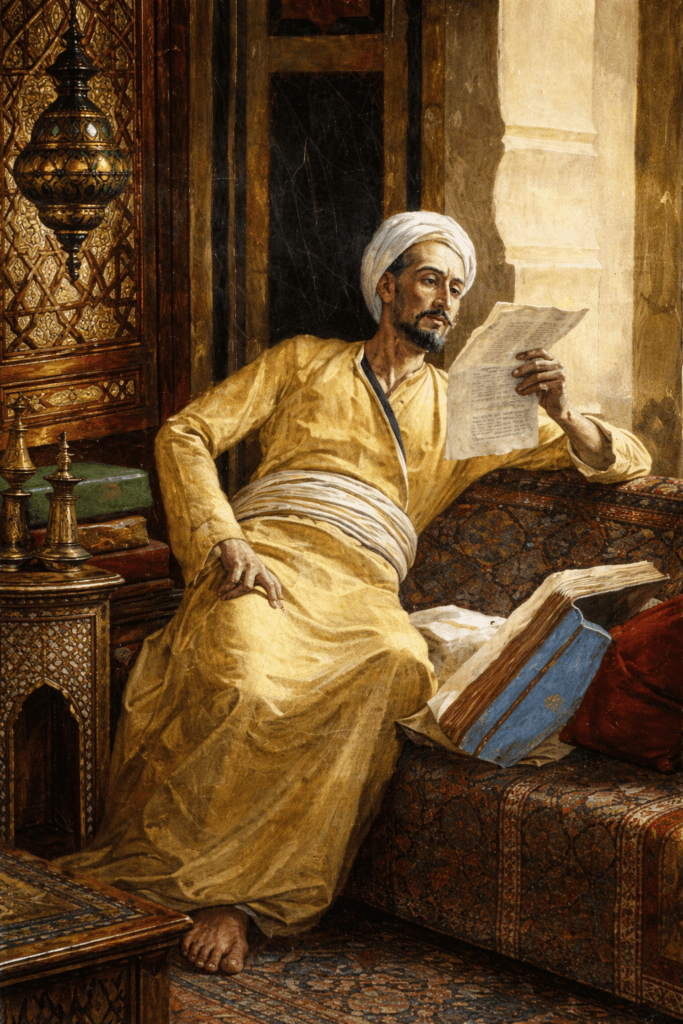
In the Islamic tradition, one of the most influential names associated with dream interpretation is Ibn Sirin. According to Ibn Sirin, dreams may contain symbolic messages related to a person’s spiritual life, moral state, and sometimes future events. He believed that some dreams may come as divine inspiration, while others are simply reflections of daily thoughts and concerns. To interpret a dream correctly, the symbols seen in the dream, the life circumstances of the dreamer, and the context in which the dream occurred must all be considered together. The method of dream interpretation developed by Ibn Sirin has influenced Islamic scholarship for centuries and continues to be one of the most important sources in the study of dream interpretation.
The Life of Ibn Sirin
Ibn Sirin is considered one of the most famous scholars in the Islamic world in the field of dream interpretation. His full name was Muhammad ibn Sirin, and he was born in the year 653 in the city of Basra, located in present-day Iraq.
He belonged to the generation known as the Tabi‘un, which refers to those who met the companions of the Prophet Muhammad and learned from them. This connection to the early Islamic scholars played a significant role in shaping Ibn Sirin’s education and intellectual development.
His father, Sirin, was originally a slave who later gained his freedom. His mother worked in the household of Anas ibn Malik, one of the companions of the Prophet Muhammad. Growing up in such a religious environment helped Ibn Sirin develop strong knowledge in Islamic sciences.
From an early age, Ibn Sirin studied hadith, Islamic jurisprudence (fiqh), and Qur’anic interpretation (tafsir). In addition to his scholarly pursuits, he also worked as a merchant and became a respected trader in Basra.
However, what made him truly famous was his deep understanding of dreams and his remarkable ability to interpret them. People from many places came to consult him about the meaning of their dreams.
Ibn Sirin did not interpret dreams based solely on symbols. Instead, he carefully considered the dreamer’s life, character, profession, and spiritual condition before giving an interpretation.
Ibn Sirin passed away in the year 728. After his death, his interpretations and teachings were compiled by scholars and preserved in books that later became foundational texts in the Islamic tradition of dream interpretation.
Ibn Sirin’s Views on Dreams
According to Ibn Sirin, dreams can generally be divided into three main categories.
1. True or Divine Dreams
These dreams are believed to come from God and may contain meaningful messages. They may bring good news, warnings, or guidance to the dreamer.
Such dreams are usually clear and emotionally powerful.
2. Psychological Dreams
These dreams are reflections of a person’s daily thoughts, worries, and desires.
For example, something that a person constantly thinks about during the day may appear in their dreams.
3. Confusing or Disturbing Dreams
These dreams are often frightening or chaotic and usually do not contain a meaningful message.
According to Ibn Sirin, such dreams should not be overanalyzed or taken too seriously.
This classification later became one of the fundamental principles of Islamic dream interpretation.



Ibn Sirin’s Method of Dream Interpretation
Ibn Sirin followed a careful and thoughtful method when interpreting dreams. According to him, dream interpretation should not rely only on symbolic meanings.
To correctly understand a dream, several factors must be considered.
1. Symbols in the Dream
Objects, animals, or events seen in dreams may carry symbolic meanings.
For example:
water → life and blessing
tree → strength or lineage
road → the direction of life
house → personal life or family
However, Ibn Sirin emphasized that symbols can have different meanings depending on the dreamer.
2. The Condition of the Dreamer
The life situation of the dreamer plays a major role in interpretation.
Important factors include:
- profession
- moral character
- spiritual condition
- life circumstances
For instance, the same symbol may have different meanings for a merchant and a student.
3. The Time of the Dream
In Islamic tradition, dreams seen close to dawn are often considered more meaningful.
Ibn Sirin also believed that the time when a dream occurs can influence its interpretation.
4. Emotional Atmosphere of the Dream
The emotions experienced during the dream are also important.
Feelings such as joy, fear, or peace can change the interpretation of the dream.
The Function of Dreams According to Ibn Sirin
Ibn Sirin believed that dreams can play an important role in human life.
He suggested that dreams may serve three main purposes.
1. Warning
Some dreams may warn a person about mistakes or potential dangers.
2. Good News
Other dreams may bring hope or indicate positive events in the future.
3. Guidance
Dreams may sometimes guide individuals toward important decisions in life.
For this reason, Ibn Sirin believed that dreams should not be dismissed as meaningless images. When interpreted wisely, they may contain valuable messages.


Examples of Dream Interpretations According to Ibn Sirin
Many symbolic interpretations are attributed to Ibn Sirin’s teachings.
Example 1: Seeing Water
Seeing clear water in a dream is often interpreted as a sign of blessing, prosperity, or knowledge.
Water may also symbolize wisdom and spiritual purity.
Example 2: Seeing a Tree
A tree in a dream may represent a strong person or a family lineage.
A fruit-bearing tree can symbolize abundance and prosperity.
Example 3: Seeing a Road
A long road may represent the journey of life.
A clear road may indicate correct decisions and guidance.
Example 4: Seeing a House
A house in a dream often represents the dreamer’s personal life or family.
A new house may symbolize a new beginning.
Famous Statements Attributed to Ibn Sirin
Several sayings attributed to Ibn Sirin reflect his perspective on dreams.
“True dreams are glad tidings for the believer.”
“A correctly interpreted dream carries a message.”
“The one who interprets dreams must possess wisdom.”
“Not every dream should be interpreted; some belong only to the dreamer.”
What Messages Do Dreams Give According to Ibn Sirin?
According to Ibn Sirin, dreams can carry meaningful signals related to a person’s life.
These messages generally relate to three important areas.
Spiritual Life
Dreams may reflect a person’s spiritual condition.
Direction in Life
Some dreams may provide clues about future decisions or life changes.
Inner Emotional State
Dreams can symbolically reveal fears, hopes, and inner thoughts.
However, Ibn Sirin also emphasized that dreams do not determine a person’s destiny. Dreams may provide signs or guidance, but human choices and actions ultimately shape life.
Ibn Sirin remains one of the most respected figures in the Islamic tradition of dream interpretation. His approach combines symbolic analysis with an understanding of the dreamer’s personal and spiritual life.
Through this balanced method, dreams are no longer seen as mysterious or meaningless images but as symbolic messages that may help people understand their lives more deeply.
According to Ibn Sirin, understanding dreams can help individuals gain insight into themselves and reflect on their life journey.
When interpreted with wisdom and knowledge, dreams may become a powerful source of guidance and inner awareness.