


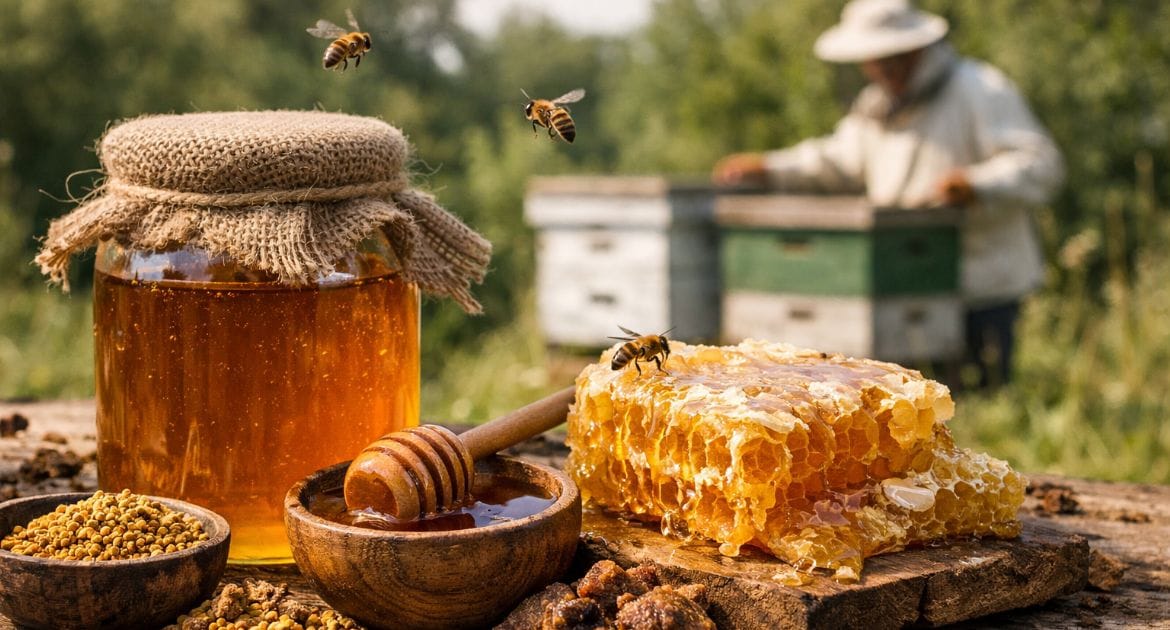
Dream about honey is considered one of the most positive dream symbols, representing abundance, lawful earnings, happiness, health, prosperity, love, spiritual peace, and the rewards of patience and hard work. Since honey is created through the persistent effort of bees over time, it symbolizes the idea that dedication, perseverance, and honest labor eventually bring meaningful rewards. However, the condition of the honey, how it is obtained, and what the dreamer does with it can significantly influence the interpretation.
What Does It Mean to Dream of Honey?
Honey is one of the oldest and most symbolically loaded substances in human history. In ancient Egypt it was a divine gift, in the Holy Scriptures it is the symbol of the “promised land,” and in the Islamic tradition it is regarded directly as a source of healing (Ciocîrlie, 2024). For this reason, regardless of the cultural lens through which it is interpreted, dreaming of honey almost always carries a positive meaning.
In classical Islamic dream interpretation, honey dreams are typically read as the glad tidings of three things:
- Lawful sustenance and abundance — expansion in livelihood, and the opening of blessed doors.
- Healing — recovery from a physical or spiritual ailment, return to health.
- Knowledge and wisdom — for those who seek learning, a sign of knowledge, understanding, and being guided to the right path.
This threefold meaning has been repeated almost unchanged in dream-interpretation treatises for centuries. In Sheikh Ali’s Ta’bîrnâme, bees and bee products are among the foremost motifs interpreted as auspicious, since the Qur’an explicitly states that the honeybee produces a “healing substance” (Önder & Büyükşekerci, 2022). Accordingly, honey dreams can be read as a reflection of a state of completion, satisfaction, and maturity within the dreamer’s inner world.
Cross-Cultural Interpretations
Honey in the Islamic Tradition
Great commentators such as Ibn Sirin, Nablusi, and Ibn al-Arabi have generally categorized honey dreams into three types:

Reklam.
- Pure, strained, fresh honey: Glad tidings, good news, and an imminent joy.
- Honey still in the comb: A lawful gain that has not yet been brought forth by labor, but which will reach its owner.
- Spoiled, soured, or adulterated honey: A cautionary dream, warning the dreamer to be vigilant about a particular intention or relationship.
In the Qur’an, in Surat An-Nahl, it is declared that the honeybee produces a healing substance, “a lesson for people who reflect” (Khan, 2021). This verse is the direct source from which honey has been associated with knowledge, contemplation, and healing in dream interpretation.
Honey in Christianity and Judaism
In the Torah and the Bible, honey is the symbol of wealth, abundance, and God’s promise. The land promised to the Israelites is described as a “land flowing with milk and honey,” where honey is a tangible metaphor for God’s love and grace toward His people (Ciocîrlie, 2024). In Christian iconography, honey is likened by the Church Fathers to the sweetness of the divine word; thus, for a believer, a honey dream can be interpreted as spiritual satisfaction and renewal of faith.
Honey in Hinduism and Buddhism
In Hindu mythology, honey is considered immortality and divine nectar. In Buddhism, “words sweet as honey” is a metaphor for the wisdom distilled from the Buddha’s teachings. In these traditions, dreaming of honey signifies that the dreamer has reached a new stage in their inner journey, attaining wisdom and tranquility (Kumar, 2024).
Honey in Ancient Greece and Mythology
In Greek mythology, Ambrosia (the food of the gods) contains honey as a component; honey was viewed as a bridge between the divine and human realms. Ancient Greek dream interpreters such as Artemidorus recorded honey dreams as generally signifying good news, gain, and health (Lowis, 2010). This tradition has also carried over into modern psychological dream analysis.
Psychological Interpretation
According to Freud
Sigmund Freud, in The Interpretation of Dreams, read dreams as the masked expression of repressed desires. Sweet, sticky symbols such as honey are, within the Freudian framework, most often associated with oral-stage gratification, sexual energy, or images of secure attachment to the mother. The texture and color of honey can be interpreted as the unconscious representation of bodily pleasure and sweetness (Lowis, 2010).
According to Jung
Carl Jung, unlike Freud, viewed dreams as the individual’s connection with the collective unconscious. From a Jungian perspective, a honey dream can be read as:
- A transition into a positive phase of the individuation process.
- The awakening of creative energy (especially the anima/animus archetype).
- The unconscious affirmation of the search for meaning.
According to Jung, a sweet dream indicates that the dreamer feels a sense of balance and wholeness within their inner world (Walker & Helm, 2009).
Modern Clinical Approach
In contemporary clinical psychology, the honey dream is evaluated as the reprocessing of positive emotional themes from daily life during sleep. According to Walker and van der Helm, 75–95% of dreams contain emotional content, with the majority occurring during REM sleep (Walker & Helm, 2009). Encountering positive symbols such as honey may therefore reflect positive emotional themes in waking life.

Neurological / Sleep Science Perspective
The neurological foundations of dreaming became central to neuroscience after Aserinsky and Kleitman discovered REM sleep in 1953 (Lowis, 2010). During REM sleep:
- Chaotic neural excitation activates the limbic system, especially the amygdala.
- Associative networks reorganize daily experiences into new dream imagery (Cai et al., 2009).
- Emotional memories are consolidated and significant experiences are reprocessed (Walker & Helm, 2009).
Dreaming of honey may therefore reflect the brain’s processing of pleasant, nourishing, and emotionally rewarding experiences. Research by Siegel (2011) and the comprehensive review by Mutti et al. (2024) further supports that dreams emerge from sleep-specific neurophysiological processes.
Honey from a Health Perspective and Tibb-e-Nabawi
Honey in the Qur’an
Surat An-Nahl states that from the honeybee comes “a drink wherein is healing for mankind” (Khan, 2021). Within the Qur’anic worldview, honey is both nourishment and healing. Honey is also described among the blessings of Paradise, emphasizing its spiritual significance (Ciocîrlie, 2024).
The Prophet’s Recommendations on Honey as Cure
Numerous authentic hadith recommend honey as a natural remedy. Contemporary medical research has confirmed several of these traditional uses, particularly its effectiveness in digestive health and diarrhea management (Suiçmez & Öztürk, 2025).
Modern Phytotherapy
Modern phytotherapy recognizes honey as:
- A natural antimicrobial agent.
- A rich antioxidant source.
- A tissue-regenerating substance.
Research also highlights its benefits in wound healing, cognitive support, immune function, and healthy aging (Ajibola et al., 2012).
What Is Honey Good For?
- Supports the immune system.
- Provides antioxidant protection.
- Promotes wound and burn healing.
- Helps soothe coughs and sore throats.
- Supports digestive health.
- May contribute to memory and cognitive performance.
Common Variations of Dreaming of Honey
Dreaming of Eating Honey
Receiving good news, healing, and abundant provision.
Dreaming of Receiving Honey
A symbol of lawful earnings and joyful news arriving soon.
Dreaming of a Beehive
Represents patience, organized work, and the reward of persistent effort.
Dreaming of Selling Honey
May symbolize honest trade, sharing knowledge, or benefiting from one’s efforts.
Dreaming of Fake Honey
A warning against deception, false promises, or dishonest relationships.
Dreaming of Honey Overflowing
Represents overwhelming abundance while also reminding the dreamer to avoid wastefulness.
Dreaming of Seeing a Lot of Honey
Symbolizes prosperity, multiple blessings, and a fortunate new period in life.
Dreaming of Stealing Honey
A warning against impatience, envy, or seeking what has not been rightfully earned.
Dreaming of Honey During Pregnancy
Generally interpreted as a sign of a healthy birth, family happiness, and future blessings.
Frequently Asked Questions
Is dreaming of honey a good sign?
Yes. Honey is widely regarded as a symbol of abundance, healing, knowledge, and good fortune.
What does dreaming of eating honey mean?
It symbolizes healing, joyful news, emotional satisfaction, and lawful provision.
What does dreaming of a beehive mean?
It represents patience, productive effort, and eventually receiving the rewards of hard work.
What does dreaming of honey during pregnancy mean?
It is commonly interpreted as a positive sign for both mother and child, symbolizing health and blessings.
Is dreaming of fake honey a bad sign?
It serves as a warning to remain cautious about deception, false expectations, or unreliable people.
Synthesis Table
| Tradition of Interpretation | Core Meaning |
|---|---|
| Cross-Cultural Interpretations | Lawful sustenance, healing, knowledge |
| Psychology (Freud & Jung) | Satisfaction, love, individuation |
| Neuroscience | Emotional memory consolidation |
| Modern Phytotherapy | Antimicrobial, antioxidant, tissue regeneration |
Dreaming of honey is a universal symbol interpreted across cultures as a sign of abundance, healing, wisdom, and positive transformation. Whether viewed through the lens of Ibn Sirin’s classical dream interpretations, Jung’s analytical psychology, or modern neuroscience, honey represents inner fulfillment, emotional nourishment, and hopeful change.
Related dreams: Dreaming of Bees • Dreaming of Water • Dreaming of Sweets.


